Presentation Details
DVTNet: Automatic Segmentation and Prediction for Deep Vein Thrombosis on Black-blood Magnetic Resonance Images using Convolutional Neural Networks
ID:58
View Protection:ATTENDEE
Updated Time:2021-11-03 21:34:01
Hits:1624
Poster Presentation
Start Time:2021-11-13 09:50(Asia/Shanghai)
Duration:5min
Session:Pos Poster »
Video
No Permission
Presentation File
Tips: Only the registered participant can access the file. Please sign in first.
Abstract
Objective: Deep vein thrombosis is the third-largest cardiovascular disease and occurs mainly in the lower extremities. Automatic and accurate venous thrombus segmentation and prediction on black-blood magnetic resonance (MR) images are significant in clinically estimating the status of post-thrombotic syndrome (PTS) and make suitable diagnostic schemes. Therefore, the Deep Vein Thrombosis Network (DVTNet) is proposed for venous thrombus segmentation and PTS prediction using convolutional neural networks.
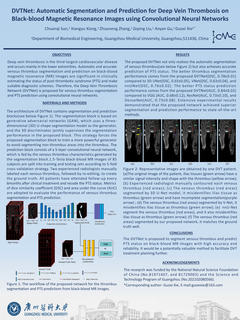
Materials and methods: The architecture of DVTNet contains segmentation and prediction blocks. The segmentation block is based on generative adversarial networks (GAN), which uses a three-dimensional (3D) U-shape segmentation model as the generator, and the 3D discriminator jointly supervises the segmentation performance in the proposed block. This strategy forces the proposed segmentation block to train a more powerful generator to avoid segmenting non-thrombus areas into the thrombus. The prediction block consists of a 5-layer convolutional neural network, which is fed by the venous thrombus characteristics generated by the segmentation block.1.5-Tesla black-blood MR images of 85 subjects are split into training and testing sets according to 5-fold cross-validation strategy. Two experienced radiologists manually labeled each venous thrombus, followed by re-editing, to create the ground truth. All patients have attended follow-up every 6months after clinical treatment and recode the PTS status. Metrics of dice similarity coefficient (DSC) and area under the curve (AUC) are adopted to evaluate the performance of venous thrombus segmentation and PTS prediction.
Results: The proposed DVTNet not only realizes the automatic segmentation of venous thrombus but also achieves accurate prediction of PTS status. The better thrombus segmentation performance comes from the proposed DVTNet(DSC, 0.78±0.01) compared to 3D UNet(DSC, 0.65±0.05), VNet(DSC, 0.63±0.04), and nnUNet(DSC, 0.76±0.02). The better PTS status prediction performance comes from the proposed DVTNet(AUC, 0.84±0.02) compared to VGG (AUC, 0.68±0.12), ResNet(AUC, 0.73±0.10), and DenseNet(AUC, 0.73±0.08). Extensive experimental results demonstrated that the proposed network achieved superior segmentation and prediction performance to state-of-the-art methods.
Conclusions: The DVTNet is proposed to segment venous thrombus and predict PTS status on black-blood MR images with high accuracy and reliability. It would be a potentially valuable method to facilitate DVT treatment planning further.
Materials and methods: The architecture of DVTNet contains segmentation and prediction blocks. The segmentation block is based on generative adversarial networks (GAN), which uses a three-dimensional (3D) U-shape segmentation model as the generator, and the 3D discriminator jointly supervises the segmentation performance in the proposed block. This strategy forces the proposed segmentation block to train a more powerful generator to avoid segmenting non-thrombus areas into the thrombus. The prediction block consists of a 5-layer convolutional neural network, which is fed by the venous thrombus characteristics generated by the segmentation block.1.5-Tesla black-blood MR images of 85 subjects are split into training and testing sets according to 5-fold cross-validation strategy. Two experienced radiologists manually labeled each venous thrombus, followed by re-editing, to create the ground truth. All patients have attended follow-up every 6months after clinical treatment and recode the PTS status. Metrics of dice similarity coefficient (DSC) and area under the curve (AUC) are adopted to evaluate the performance of venous thrombus segmentation and PTS prediction.
Results: The proposed DVTNet not only realizes the automatic segmentation of venous thrombus but also achieves accurate prediction of PTS status. The better thrombus segmentation performance comes from the proposed DVTNet(DSC, 0.78±0.01) compared to 3D UNet(DSC, 0.65±0.05), VNet(DSC, 0.63±0.04), and nnUNet(DSC, 0.76±0.02). The better PTS status prediction performance comes from the proposed DVTNet(AUC, 0.84±0.02) compared to VGG (AUC, 0.68±0.12), ResNet(AUC, 0.73±0.10), and DenseNet(AUC, 0.73±0.08). Extensive experimental results demonstrated that the proposed network achieved superior segmentation and prediction performance to state-of-the-art methods.
Conclusions: The DVTNet is proposed to segment venous thrombus and predict PTS status on black-blood MR images with high accuracy and reliability. It would be a potentially valuable method to facilitate DVT treatment planning further.
Keywords
convolutional neural networks;venous thrombus segmentation;post-thrombotic syndrome prediction
Speaker

Chuanqi Sun
Guangzhou Medical UniversitySubmission Author
All Comments
Important Date
-
Conference Date
Nov 13
2021
toNov 14
2021
-
Sep 30 2021
Contribution Submission Deadline
-
Nov 14 2021
Registration deadline
Sponsored By
Medical Physics Branch of Chinese Society of Biomedical Engineering
IEEE Beijing Section
Life Electronics Society of Chinese Institute of Electronics
IEEE Beijing Section
Life Electronics Society of Chinese Institute of Electronics
Organized By
Anhui Biomedical Engineering Society.
University of Science and Technology of China
University of Science and Technology of China
Contact Information
- Mrs. Yang
- ic******@ustc.edu.cn
- +86********
Previous Conferences
-
2017-11-04 China Beijing,China
2017 International Conference on Medical Imaging Physics and Engineering -
2017-11-03 China 海淀区
2017 IEEE 国际医学影像物理和工程大会 -
2013-10-19 China 沈阳市
2013 IEEE International Conference on Medical Imaging Physics and Engineering (ICMIPE)

Submit Comment