Presentation Details
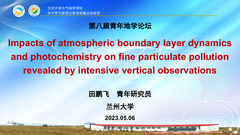
Impacts of atmospheric boundary layer dynamics and photochemistry on fine particulate pollution revealed by intensive vertical observations
ID:3507
View Protection:PRIVATE
Updated Time:2023-05-06 11:19:17
Hits:2087
Oral Presentation
Start Time:2023-05-06 15:50(Asia/Shanghai)
Duration:15min
Session:14B 14B、气溶胶与大气环境 »
Abstract
The fine particulate matter pollution in winter that still exists under the emission reduction situation has a more complex formation mechanism. The effects of boundary layer dynamics and chemistry on air pollution are not sufficiently understood due to the lack of vertical observations. Therefore, this study collected comprehensive observations, including the vertical distribution of PBL dynamics, aerosol optical properties, and PM2.5 chemical composition, in a semi-arid city in western China from 4 Jan to 31 Jan 2021. The air pollution during the field campaign was divided into three levels: excellent (20%), good (56%), and polluted (24%). The results showed as follows: the aerosol optical depth (AOD) was the smallest in the excellent level, while AOD was comparable in the good and polluted levels due to the difference in the vertical distribution of aerosols, i.e., the extinction lapse rate in the good level (0.12 km−2) was smaller than that in the polluted level (0.19 km−2). The boundary layer stability structures reflected by gradient Richardson number (Ri) profiles with high vertical resolution can significantly influence the vertical distributions of aerosols. Amounts of pollutants were removed from the basin when the synoptic weather systems and boundary layer were unstable (Ri < 0.25) causing the excellent level, while the very stable boundary layer (Ri > 1) decoupled the pollutants with clean air out of the basin and trapped them in the lower layer causing the polluted level. However, the pollution mechanism under the good level was more complex due to the effect of the coupled boundary layer dynamics and chemistry. The precursors were vertical mixing to the higher layer by the unstable lower and middle boundary layer (Ri < 0.25), and thus the photochemistry was enhanced with the stronger solar radiation, especially in the 0.42 km height. This phenomenon was also indicated by the difference in daytime and nighttime extinction coefficient profiles and the proportion of secondary inorganic aerosols (SIAs) at different heights. This paper provides observational evidence for the significant influence of the coupled atmospheric physical and chemical processes on the vertical distribution of aerosol and particulate pollution levels at the surface.
Keywords
Particulate pollution, vertical distribution, boundary layer dynamics, photochemistry, in situ observations.
Speaker

田鹏飞
青年研究员 兰州大学Submission Author
All Comments
Important Date
-
Conference Date
May 05
2023
toMay 08
2023
-
Mar 31 2023
Draft paper submission deadline
-
May 25 2023
Registration deadline
Sponsored By
青年地学论坛理事会
中国科学院青年创新促进会地学分会
中国科学院青年创新促进会地学分会
Organized By
武汉大学
中国科学院精密测量科学与技术创新研究院
中国地质大学(武汉)
中国科学院精密测量科学与技术创新研究院
中国地质大学(武汉)
Contact Information
- 管小彬
- gu******@whu.edu.cn
- +86********
- 孙佳妮
- sc******@aconf.org
- +86********

Submit Comment