Presentation Details
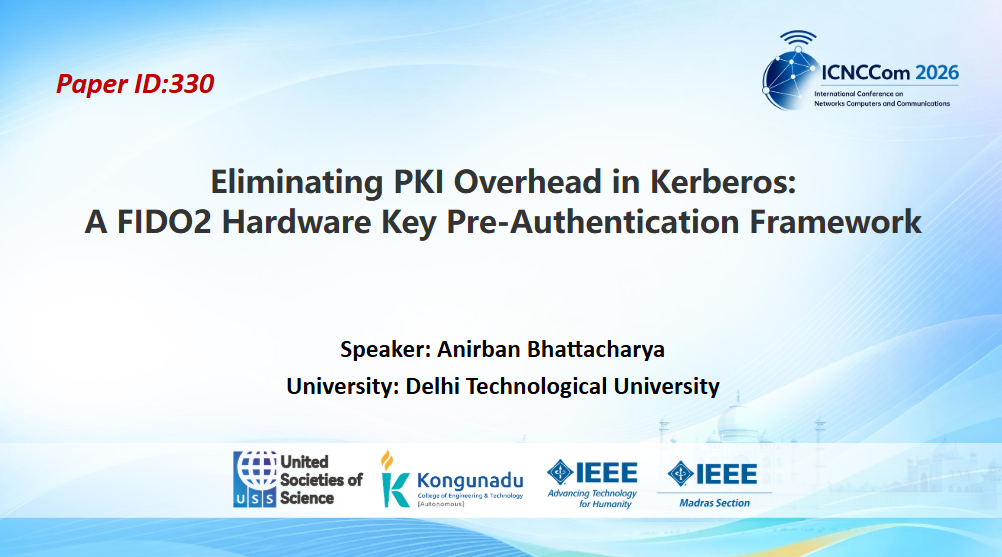
Eliminating PKI Overhead in Kerberos: A FIDO2 Hardware Key Pre-Authentication Framework
ID:49
View Protection:ATTENDEE
Updated Time:2026-07-30 14:42:37
Hits:23
Online
Start Time:2026-07-30 12:25(Asia/Kolkata)
Duration:15min
Session:S3 Cyber Security »
Video
No Permission
Presentation File
Tips: Only the registered participant can access the file. Please sign in first.
Abstract
Despite the widespread use of passwordless Fast IDentity Online 2 (FIDO2)-based systems for authentication on contemporary websites, enterprise networks continue to reply on legacy Kerberos V5 mechanisms and the highly vulnerable practice of storing symmetric password hashes. This reliance leaves organizations susceptible to catastrophic credential breaches, including Pass-the-Hash and AS-REP Roasting attacks. While there exist hardware-based defenses, such as the Public Key Cryptography for Initial Authentication (PKINIT) extension, which solve the problem of using passwords but require considerable operational expenditure due to the necessity of setting up a Public Key Infrastructure (PKI). To address this infrastructure bottleneck, a novel ”Zero-PKI” pre-authentication method is proposed, allowing the seamless integration of FIDO hardware tokens into legacy Kerberos environment without additional infrastructure overhead. Running entirely within the RFC 6113 protocol framework, the architecture ensures strict separation of duties. FIDO trust anchors are stored in a lightweight auxiliary database, while the essential Kerberos Database stays completely unaltered. By replacing static passwords with an ephemeral cryptographic challenge-response mechanism, this approach achieves the same level of protection offered by PKINIT without relying on external infrastructure.
Keywords
Kerberos,FIDO2,Passwordless Authentication,Zero-P,Applied Cryptography,Formal Verification
Speaker

Anirban Bhattacharya
Mtech Student Mtech StudentSubmission Author
All Comments
Important Date
-
Conference Date
Jul 30
2026
toAug 01
2026
-
Jul 28 2026
Draft paper submission deadline
-
Aug 03 2026
Registration deadline
Sponsored By
The United Societies of Science
Organized By
Kongunadu College of Engineering and Technology
Supported By
IEEE Section
IEEE Madras Section
IEEE Madras Section
Contact Information
Previous Conferences
-
2026-07-30 India Trichy
2026 International Conference on Networks Computers and Communications

Submit Comment