Presentation Details
Distributed EEG Motor Imagery Classification using Federated Common Spatial Patterns
ID:6
View Protection:ATTENDEE
Updated Time:2026-07-22 16:08:58 Hits:34
Online
Start Time:2026-07-30 11:40(Asia/Kolkata)
Duration:15min
Session:S4 Computer Vision and Pattern Recognition »
Video
No Permission
Presentation File
Attachment File
Tips: Only the registered participant can access the file. Please sign in first.
Abstract
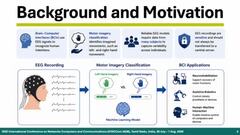
Electroencephalography (EEG)-based motor imagery decoding plays an important role in brain-computer interface (BCI) systems. However, collecting and centralizing EEG data from multiple users raises significant privacy and data-sharing concerns. Federated learning provides a promising paradigm for collaborative model training across distributed clients without transferring raw neural recordings. Nevertheless, the high inter-subject variability of EEG signals often leads to unstable optimization and degraded performance in federated environments. In this work, we propose a lightweight federated EEG classification framework that integrates Filter Bank Common Spatial Pattern (FBCSP) feature extraction with a distributed classifier trained using the Federated Averaging (FedAvg) algorithm. In the proposed pipeline, each subject is treated as an independent federated client, enabling collaborative learning while preserving data locality. Experiments were conducted on the EEG Motor Movement/Imagery dataset from PhysioNet involving 100 subjects performing left- and right-hand motor imagery tasks. The results demonstrate that the proposed federated FBCSP framework achieves a classification accuracy of approximately 89.3%, significantly outperforming the baseline federated model which converges at around 81-82% accuracy. On average, the proposed method achieves a mean accuracy of 88.83%, compared with 80.95% for the baseline approach. In addition, the federated training process exhibits stable convergence, improving from approximately 79.9% accuracy in early communication rounds to 89.3% after 50 rounds. Our findings indicate that incorporating domain-specific spatial filtering significantly improves the robustness of federated EEG learning by reducing cross-subject variability before distributed optimization. As a result, the proposed framework demonstrates that combining classical EEG signal processing techniques with federated learning provides an effective and privacy-preserving solution for large-scale collaborative BCI model training without requiring centralized access to sensitive neural data.
Keywords
Brain–Computer Interface,Electroencephalography Signal,Filter Bank Common Spatial Pattern,Motor Imagery Classification,Privacy-Preserving Machine Learning
Speaker

Kundjanasith THONGLEK
Lecturer Kasetsart UniversitySubmission Author
All Comments
Important Date
-
Conference Date
Jul 30
2026
toAug 01
2026
-
Jul 28 2026
Draft paper submission deadline
-
Jul 28 2026
Registration deadline
Sponsored By
The United Societies of Science
Organized By
Kongunadu College of Engineering and Technology
Supported By
IEEE Section
IEEE Madras Section
IEEE Madras Section
Contact Information
Previous Conferences
-
2026-07-30 India Trichy
2026 International Conference on Networks Computers and Communications

Submit Comment