Presentation Details
3D Printing Cellulose Nanofibers for Constructing Multifunctional Materials
ID:18
View Protection:PRIVATE
Updated Time:2021-11-01 10:07:40
Hits:1359
Oral Presentation
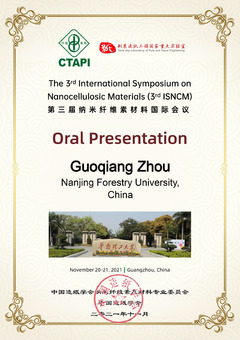
Start Time:2021-11-20 17:15(Asia/Shanghai)
Duration:20min
Session:SC The 3rd International Symposium on Nanocellulosic Materials-Oral Session (ROOM 3) »
Abstract
Cellulose nanomaterials (CNMs) derived from biomass resources have the characteristics of renewability, biodegradability, high specific surface area, and excellent mechanical properties. More importantly, the adjustable rheological properties of CNM suspension enable it to be applied for 3D printing. For 3D printing technology of direct ink writing, the rheological properties of ink directly affect the printability and structural stability, and the printing parameters (e.g., printing pressure & speed) determine the precision of the extruded filaments and constructure fidelity. Moreover, the functionalization of 3D printed CNM-constructs is also of great significance to expand its applications. Herein, cellulose nanofibers (CNFs) extracted from waste oil palm trunk by TEMPO-mediated oxidation were used to construct multifunctional materials through 3D printing technique. The rheological performance of CNF ink with different concentrations were evaluated. Subsequently, the printing parameters were optimized and different 3D structures were obtained after freeze-drying. Finally, aniline monomers (ANi) were in situ polymerized onto the 3D scaffold to achieve electrical conductivity and energy storage performance. The results show that (1) the as-prepared CNFs have an mean diameter of ~7.13 nm and carboxyl group content of 0.75 mmol·g-1 on the surface; (2) CNF ink is a typical non-Newtonian fluid with the shear thinning behavior, which is conducive to be smoothly extruded from the nozzle; (3) The viscosity, storage modulus and yield stress of the ink are positively correlated with the concentration of CNFs, hence increasing the concentration is beneficial to the stability of the 3D printing structure; (4) Enhancing printing pressure or reducing the printing speed would decay the printing accuracy; (5) The printed scaffold shows good shape fidelity before and after freeze-drying, and the freeze-dried scaffold has porous structure, exhibiting excellent thermal insulation performance; (6) By in-situ polymerization of aniline on 3D printed scaffold, the scaffold shows excellent electrical conductivity and energy storage properties. This work demonstrates the extraction of CNFs from waste oil palm trunk, optimization of CNF ink and printing parameters toward superior printability, structural stability and shape fidelity, as well as the application of 3D printed constructs in thermal insulation and energy storage devices. These findings not only enrich the high-value utilization of waste oil palm trunk, but also pave the way to produce complicated 3D structure based on CNF ink through direct ink writing technique.
Keywords
Speaker

Guoqiang Zhou
Doctor Nanjing Forestry UniversitySubmission Author
All Comments
Important Date
-
Conference Date
Nov 20
2021
toNov 21
2021
-
Nov 16 2021
Draft paper submission deadline
-
Nov 18 2021
Contribution Submission Deadline
-
Nov 18 2021
Registration deadline
Sponsored By
China Paper Industry Technical Association
Organized By
South China University of Technology
Contact Information
- Mr. Tao Song
- s******@scut.edu.cn
- 180********
Previous Conferences
-
2025-05-09 China 福州
2027年纳米纤维素材料国际会议 -
2023-04-21 China 北京
The 4th International Symposium on Nanocellulosic Materials

Submit Comment