Presentation Details
Surface potential tailoring and its contribution to the contact electrification of cellulose nanofibrils
ID:29
View Protection:PRIVATE
Updated Time:2021-10-29 10:44:23 Hits:1259
Oral Presentation
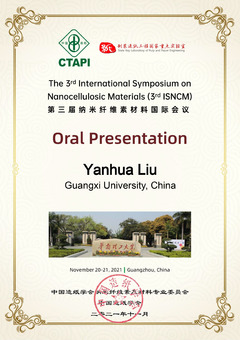
Start Time:2021-11-21 11:25(Asia/Shanghai)
Duration:20min
Session:SB The 3rd International Symposium on Nanocellulosic Materials-Oral Session (ROOM 2) »
Abstract
Contact electrification is a phenomenon in which two materials that come into contact become charged. Studying the surface potential of materials is greatly significant for further understanding the source of contact electrification. However, the effect of the surface potential of a material on contact electrification has not been elucidated in detail. Greater the surface potential difference between materials results in greater triboelectric performance, that is, the amount of electron gain or loss on the material surface is directly related to the amount of charge generated by contact electrification. Researchers have tested various materials and developed a triboelectric series. The triboelectric output from two materials coming into contact is related to the positions of the materials within this series, and these positions are related to the surface potentials of the materials. Therefore, it is necessary to systematically study the relationship between surface potential and contact electrification to improve the electrification performance of materials. The surface potential of a material is primarily determined by its functional groups; therefore, it can be tailored by changing these surface functional groups. In this work, silane coupling agents with the same main chain but different terminal functional groups were selected to tailor the surface potential of cellulose nanofibrils to study the relationship between surface potential and contact electrification. Kelvin probe force microscopy was used to measure the surface potential of cellulose nanofibrils before and after modification. The results show that the positive and negative surface potential of a material can be altered by introducing functional groups with different electron-withdrawing or electron-donating abilities to its surface. By regulating the number and density of the functional groups, the range of the surface potential can be tailored more specifically. More importantly, the surface potential affects the polarity of the material and the number of electrons transferred. Materials with a high surface potential tend to lose electrons, and vice versa. These results are further explained by the principles of surface potential testing and the electron-cloud-potential-well model, which also revealed the mechanisms behind metal–polymer and polymer–polymer contact. This work studies the correlation between surface potential and contact electrification and provides guidance for researchers exploring contact electrification.
Keywords
surface potential, contact electrification, cellulose nanofibrils, polymer electrification, functional-group density
Speaker

Yanhua Liu
Postgraduate Guangxi UniversitySubmission Author
All Comments
Important Date
-
Conference Date
Nov 20
2021
toNov 21
2021
-
Nov 16 2021
Draft paper submission deadline
-
Nov 18 2021
Contribution Submission Deadline
-
Nov 18 2021
Registration deadline
Sponsored By
China Paper Industry Technical Association
Organized By
South China University of Technology
Contact Information
- Mr. Tao Song
- s******@scut.edu.cn
- 180********
Previous Conferences
-
2025-05-09 China 福州
2027年纳米纤维素材料国际会议 -
2023-04-21 China 北京
The 4th International Symposium on Nanocellulosic Materials

Submit Comment