Presentation Details
Rheological properties of cellulose nanomaterials and their application in drilling fluids
ID:38
View Protection:PRIVATE
Updated Time:2021-11-02 14:50:17
Hits:1264
Oral Presentation
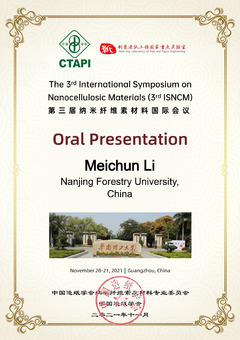
Start Time:2021-11-21 15:15(Asia/Shanghai)
Duration:20min
Session:SA The 3rd International Symposium on Nanocellulosic Materials-Oral Session (ROOM 1)) »
Abstract
Cellulose nanomaterials (CNMs), including cellulose nanofibers (CNFs) and cellulose nanocrystals (CNCs) exhibit promising rheological properties, when they are suspended in an aqueous solution.[1] CNMs can create highly viscous suspension through the formation of percolation networks and various chemical interactions (e.g., van der Waals forces, hydrogen bonding, electrostatic attraction, electrostatic repulsion, and hydrophobic attraction).[2] Under continuous shearing, CNMs orient along the shearing direction, yielding notable shear-thinning behavior, i.e., viscosity decreasing with increased shear rate. When standing, CNMs regain much of their initial structure in a short time (i.e., good thixotropic performance), enabling rapid recovery of steady-state viscosity and viscoelastic properties of CNM suspension. These attractive rheological features together with the abundant, green, sustainable, biodegradable and biocompatible merits allow CNMs to serve as effective rheological modifiers in a wide range of applications, e.g., 3D printing inks, food products, coating and paints, personal care products, construction and oilfield serving fluids. In this presentation, we will give a summary of the flow behaviors of CNM suspension, including the flocculation, lyotropic phase and shear-induced orientation of CNM, towards a better understanding of the complicated rheological properties of CNM suspension. Many parameters, such as test protocol, and concentration, morphology, and surface characteristics of CNMs, strongly affect the rheological properties of CNM suspension as well. Then, the dependence of steady-state viscosity and viscoelastic properties of CNM suspension on those parameters will be discussed, making it possible to more effectively utilize them as rheological modifiers in water-based drilling fluids. Subsequently, we will report our research progress in the applications of CNMs as rheological modifiers in bentonite water-based drilling fluids. The influences of morphology[3] and surface charge[4] of CNMs, water-soluble polymer addition (i.e., polyanionic cellulose),[5,6] as well as surface functionalization of CNMs with thermo-thickening polymer [i.e., poly(2-acrylamido-2-methyl-1-propanesulfonic acid-co-N-isopropylacrylamide)][7] and salt-resistant polymer [i.e., poly(acrylamide-co-2-acrylamido-2-methyl-1-propanesulfonic acid)][8] on the rheological performance of bentonite water-based drilling fluids will be presented. The possible surface interaction between BT and CNMs will be discussed based on the microstructure analyses in order to reveal the mechanism on the rheology enhancement. Finally, future perspectives are supplied to further guide research and development in using CNMs as the next generation rheological modifiers in drilling fluids.
Keywords
Speaker

Meichun Li
Professor Nanjing Forestry UniversitySubmission Author
All Comments
Important Date
-
Conference Date
Nov 20
2021
toNov 21
2021
-
Nov 16 2021
Draft paper submission deadline
-
Nov 18 2021
Contribution Submission Deadline
-
Nov 18 2021
Registration deadline
Sponsored By
China Paper Industry Technical Association
Organized By
South China University of Technology
Contact Information
- Mr. Tao Song
- s******@scut.edu.cn
- 180********
Previous Conferences
-
2025-05-09 China 福州
2027年纳米纤维素材料国际会议 -
2023-04-21 China 北京
The 4th International Symposium on Nanocellulosic Materials

Submit Comment