Presentation Details
Fabrication of Nanolcellulose stabilized nano zero-valent iron for Heavy metal removal
ID:56
View Protection:PRIVATE
Updated Time:2021-11-10 08:41:54 Hits:1369
Poster Presentation
Start Time:2021-11-20 19:10(Asia/Shanghai)
Duration:10min
Session:Po2 The 3rd International Symposium on Nanocellulosic Materials-poster2 (ROOM 2) »
Abstract
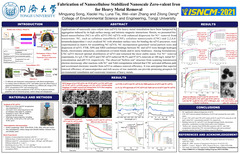
Nano zero-valent iron (nZVI) was easy to aggregate due to the weak van der Waals forces and intrinsic magnetic interactions, seriously restricting its practical application in environmental remediation. Renewable and biodegradable nanocellulose derived from the most abundant natural polymer were favored as functional matrices for stabilizing nZVI, bringing our attention to the efficient in-situ and ex-situ treatment for heavy metal removal [1]. Herein, that cellulose nanofibers (CNF) and cellulose nanocrystals (CNC) fine-tuned nZVI (nanocellulose-nZVI) were synthesized by facile one-pot in-situ method and weakened the aggregation of nZVI were implemented for Ni2+ removal from wastewater. One-pot in-situ synthesis was carried out by optimizing the reduction process of ferric chloride via sodium borohydride from our group [2]. Nanocellulose-nZVI presented chain-like structure with spherical shaped nanoparticles (Fig. 1a). In successfully synthesized nanocomposites, combination between nanocellulose and nZVI, FTIR spectrum revealed (Fig. 1b), bonded through hydroxyl groups at amorphous regions of CNF-nZVI and highly crystalline regions of CNC-nZVI due to varied intrinsic structures of nanocellulose [3]. Moreover, all involved in electrostatic interactions to anchor nZVI. Quiescent sedimentation test demonstrated nanocellulose modifications significantly enhanced stability and dispersity of nZVI. This was probably because of enhanced electrostatic repulsion between nanocomposites derived from high surface charges and narrowed distribution of polydispersity resulted in highly uniformed colloidal suspensions, contributing to more surface active sites for the targeted heavy metal. The corrosion potential (Icorr) illustrated from Tafel extrapolation of polarisation curves ranked as a decreasing series: CNC-nZVI > CNF -nZVI > bare nZVI (Fig. 1c), indicating CNs accelerated the electronic transfer of inner Fe(0) through the surface of nanocellulose-nZVI. For Ni2+ removal from batch experiment, both CNF-nZVI and CNC-nZVI eliminated over 97% of heavy metal at the equilibrium after 120 min (Fig. 1d). In addition, both kinetic equations were better fitted to pseudo-second-order kinetic models, indicating simultaneous mechanism of physical adsorption of Ni2+ onto surface of CNs-nZVI combined with chemsorption and reductive transformation during Ni2+ removal. Therefore, such variations in particle size, stability, bondings and electron transfer rates as had been demonstrated in CNF-nZVI and CNC-nZVI, remained remarkable in significance for correlation with enhancing efficiency of heavy metal removal.
- Wang Y, Zhang L, Zhou J, et al. Flexible and Transparent Cellulose Based Ionic Film as Humidity Sensor[J]. ACS Applied Materials & Interfaces, 2020, 12(6):7631-7638.
- Zhang W X. Nanoscale Iron Particles for Environmental Remediation: An Overview[J]. Journal of Nanoparticle Research, 2003, 5(3-4):323-332.
- Habibi Y, Lucia L A, Rojas O J. Cellulose nanocrystals: chemistry, self-assembly, and applications.[J]. Chemical Reviews, 2010, 110(6):3479-3500.
Keywords
Nanocellulose; Nano zero-velent iron; Heavy metal; Wastewater
Speaker

Song Mingyang
Graduate student Tongji UniversitySubmission Author
All Comments
Important Date
-
Conference Date
Nov 20
2021
toNov 21
2021
-
Nov 16 2021
Draft paper submission deadline
-
Nov 18 2021
Contribution Submission Deadline
-
Nov 18 2021
Registration deadline
Sponsored By
China Paper Industry Technical Association
Organized By
South China University of Technology
Contact Information
- Mr. Tao Song
- s******@scut.edu.cn
- 180********
Previous Conferences
-
2025-05-09 China 福州
2027年纳米纤维素材料国际会议 -
2023-04-21 China 北京
The 4th International Symposium on Nanocellulosic Materials

Submit Comment