Presentation Details
STABILIZATION OF BIODIESEL/WATER PICKERING EMULSION USING CELLULOSE NANOMATERIALS WITH TAILORED MORPHOLOGY AND SURFACE CHEMISTRY
ID:68
View Protection:PRIVATE
Updated Time:2021-11-13 14:49:33 Hits:1383
Poster Presentation
Start Time:2021-11-20 18:20(Asia/Shanghai)
Duration:10min
Session:Po2 The 3rd International Symposium on Nanocellulosic Materials-poster2 (ROOM 2) »
Abstract
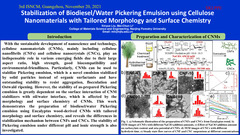
With the sustainable development of nanoscience and technology, cellulose nanomaterials (CNMs), mainly including cellulose nanofibrils (CNFs) and cellulose nanocrystals (CNCs), play an indispensable role in various emerging fields due to their large aspect ratio, high strength, good biocompatibility and environmental-friendliness. Particularly, CNMs can be used to stabilize Pickering emulsion, which is a novel emulsion stabilized by solid particles instead of organic surfactants and have outstanding stability to resist aggregation, flocculation and Ostwald ripening. However, the stability of as-prepared Pickering emulsion is greatly dependent on the surface interaction of CNM stabilizers with oil/water interface, which is especially affected by the morphology and surface chemistry of CNMs.
In this study, CNFs and CNCs were successfully isolated from Eucalyptus powders (100 mesh) by TEMPO-mediated oxidization and H2SO4 hydrolysis, respectively. The morphology, crystallinity and surface chemistry of CNMs were tailored as functions of NaClO content and acid hydrolysis time. The results show that the carboxyl content and zeta potential of CNFs were gradually enhanced with the increase in NaClO content, but the crystallinity was not changed appreciably. The particle diameter distribution of CNFs changed from bimodal (5 nm and 8 nm) to unimodal (3.5 nm) when the amount of NaClO increased from 4 to 8 mM, respectively. And with further increase in NaClO content to 10 mM, CNFs reached the minimum diameter of only 2.7 nm. As for CNCs, when the hydrolysis time was extended from 90 to 180 min, the cross-sectional diameter and length decreased from bimodal 5.3/7.7 nm and 220 nm to uniform 2.8 nm and 136 nm, respectively. Although the size distribution of CNCs became more uniform, its crystallinity was significantly reduced after prolonged hydrolysis, which is attributed to the fact that an excessive acid hydrolysis time can eliminate both the amorphous and crystalline regions.
The resultant CNMs were then used as stabilizers to prepare biodiesel/water Pickering emulsion through ultrasonic emulsification. The impacts of power and time of ultrasonication, CNM’s properties and concentration, as well as water-oil ratio on the stability of Pickering emulsion were comprehensively investigated. It was observed that the formation of biodiesel/water Pickering emulsion became easier with the enhancement of ultrasonic time and power to a certain span. The morphology and surface properties of CNMs affected the stability of biodiesel/water Pickering emulsion significantly. In comparison with CNCs, CNFs showed better stabilizing effect due to the formation of highly entangled network. Furthermore, the increases in CNM concentration and water-oil ratio were also advantageous for the formulation of highly stable biodiesel/water Pickering emulsion. These results demonstrated that CNMs can be used as green, sustainable and efficient stabilizers to prepare biodiesel/water Pickering emulsion, and the stability can be improved by optimizing a various set of parameters. The above findings serve as a crucial step forward toward the development and application of high-performance CNM-stabilized biodiesel/water Pickering emulsion in petroleum industry, e.g., emulsion-based nanofluids for drilling, fracturing and enhanced oil recovery.
Keywords
Cellulose nanomaterials; Morphology; Surface chemistry; Pickering emulsion; Stabilization
Speaker

Xinyue Liu
Nanjing Forestry UniversitySubmission Author
All Comments
Important Date
-
Conference Date
Nov 20
2021
toNov 21
2021
-
Nov 16 2021
Draft paper submission deadline
-
Nov 18 2021
Contribution Submission Deadline
-
Nov 18 2021
Registration deadline
Sponsored By
China Paper Industry Technical Association
Organized By
South China University of Technology
Contact Information
- Mr. Tao Song
- s******@scut.edu.cn
- 180********
Previous Conferences
-
2025-05-09 China 福州
2027年纳米纤维素材料国际会议 -
2023-04-21 China 北京
The 4th International Symposium on Nanocellulosic Materials

Submit Comment