Presentation Details
Bio-inspired anisotropic eood-based hydrogel composites for bone repair
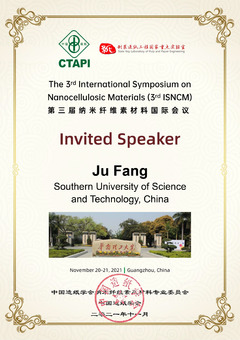
Start Time:2021-11-20 14:25(Asia/Shanghai)
Duration:25min
Session:P The 3rd International Symposium on Nanocellulosic Materials-Room 1 »
Abstract
Anisotropic hydrogels mimicking the biological tissues with directional functions play essential roles in damage-tolerance, cell guidance and mass transport. Conventional synthetic hydrogels often have isotropic network structure, insufficient mechanical properties and lack of bio-functionalities, which greatly limit their applications for load-bear tissue engineering. Inspired by natural bone and wood, we develop a biomimetic strategy to fabricate highly anisotropic, ultrastrong and stiff, and osteoconductive wood-based hydrogel composites via impregnation of biocompatible sodium alginate hydrogels into the delignified pinewood followed by in-situ mineralization of hydroxyapatite (HAp) nanocrystals. By delignification, the porous structure of the delignified wood significantly benefits the infiltration of alginate hydrogel. The well-aligned cellulose nanofibrils endow the hydrogel composites with highly anisotropic structural and mechanical properties. The strong intermolecular bonds of the aligned cellulose fibrils and alginate/cellulose interaction, and the reinforcing nanofillers of HAp enable the hydrogel composites remarkable tensile strength of 67.8 MPa and elastic modulus of 670 MPa, which exceed almost all the currently available strong hydrogels. The presented hydrogel composites exhibit not only strong and anisotropic mechanical properties, but also bone-mimicking structural and compositional characteristics. In vitro, this mineralized wood-based hydrogel (MWH) can promote pre-osteoblast adhesion, spreading, proliferation and osteogenic differentiation. In vivo, the MWH can accelerate bone regeneration and enhance new bone ingrown to the scaffold. Our study provides a low-cost, eco-friendly, feasible and scalable approach for fabricating anisotropic, strong, stiff, hydrophilic and osteoconductive hydrogel composites for bone repair.
Keywords
Speaker

Fang Ju
professor Southern University of Science and Technology, ChinaDr. Ju Fang (Research Assistant Professor)
Faculty of Engineering, Department of Material Science and Engineering,
Southern University of Science and Technology.
Dr. Fang studied resource science and engineering at South China University of Technology from 2005 to 2009. He completed his master’s degree in pulp and paper engineering there. From 2012, supported by the China Scholarship Council, he was worked as a Ph.D. studentship in Professor Tetsuo Kondo’s group, Kyushu University, Japan. He received his doctorate from the Graduate School of Bioresource and Bioenvironmental Sciences, Kyushu University in 2015. After returning to China, he worked as a postdoc in the Department of Material Science and Engineering, Southern University of Science and Technology, Shenzhen. Since 2019, he has been a research assistant professor at Southern University of Science and Technology.
Inspired by nature, materials with biomimetic structures, morphologies, and functions can be achieved. It is essential to to clarify the relationship between the properties of materials and cellular functions. Base on these concepts, Fang and his co-works attempt to search for environmental and economic friendly strategies to construct biomimetic functional materials for tissue engineering.
All Comments
Important Date
-
Conference Date
Nov 20
2021
toNov 21
2021
-
Nov 16 2021
Draft paper submission deadline
-
Nov 18 2021
Contribution Submission Deadline
-
Nov 18 2021
Registration deadline
Sponsored By
Organized By
Contact Information
- Mr. Tao Song
- s******@scut.edu.cn
- 180********
Previous Conferences
-
2025-05-09 China 福州
2027年纳米纤维素材料国际会议 -
2023-04-21 China 北京
The 4th International Symposium on Nanocellulosic Materials

Submit Comment