Presentation Details
Cellulose hydrogels and membranes

Start Time:2021-11-20 16:25(Asia/Shanghai)
Duration:25min
Session:SB The 3rd International Symposium on Nanocellulosic Materials-Oral Session (ROOM 2) »
Abstract
Meanwhile, with the development of green cellulose dissolution solvents, cellulose emerges as a promising alternative material to construct high-performance hydrogels. Promoted by the inorganic salt system, flexible, anti-freezing and conductive cellulose hydrogels can be designed and prepared in a facile way. By retaining the metal salts in the hydrogel, this preparation approach realizes a perfect combination of cellulose dissolution and hydrogel fabrication process. Moreover, the zinc ions involved hydrogels can be further assembled into supercapacitors or batteries for electrochemical applications. In sum, cellulose hydrogels and membranes have excellent properties and can be given required functions through regulation and design. In this talk, I will share our latest work to develop cellulose hydrogels and membranes and a specific focus will be on gas separation membranes and zinc ionic hydrogels.
Keywords
Speaker
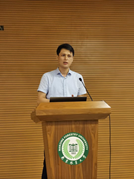
Yao Jianfeng
professor Nanjing Forestry University, ChinaJianfeng Yao currently is a Professor in Chemical engineering at Nanjing Forestry University. He received his BE and PhD in Chemical Engineering from Nanjing University of Technology in China in 2000 and 2005, respectively. His research focuses on the preparation of cellulose-based functional materials as well as their applications as separation membranes and smart devices. He has published more than 200 journal articles in various fields of polymer science and engineering. His Google citation exceeds 9000 and his h-index is 57.
All Comments
Important Date
-
Conference Date
Nov 20
2021
toNov 21
2021
-
Nov 16 2021
Draft paper submission deadline
-
Nov 18 2021
Contribution Submission Deadline
-
Nov 18 2021
Registration deadline
Sponsored By
Organized By
Contact Information
- Mr. Tao Song
- s******@scut.edu.cn
- 180********
Previous Conferences
-
2025-05-09 China 福州
2027年纳米纤维素材料国际会议 -
2023-04-21 China 北京
The 4th International Symposium on Nanocellulosic Materials

Submit Comment