Presentation Details
Fabrication of nanocellulosic materials from cellulose and lignocellulose using molten salt hydrate and their environmental and energy applications
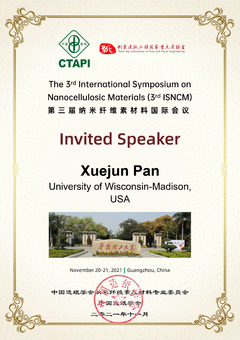
Start Time:2021-11-21 08:30(Asia/Shanghai)
Duration:25min
Session:SB The 3rd International Symposium on Nanocellulosic Materials-Oral Session (ROOM 2) »
Abstract
Keywords
Speaker

Pan Xuejun
professor University of Wisconsin-Madison, USADr. Xuejun Pan is a Professor in the Department of Biological Systems Engineering at the University of Wisconsin-Madison. He earned his Bachelor's, Master's, and Ph.D. degrees in Chemical Engineering (Pulp & Paper) at Tianjin University of Science and Technology, China, and the second Ph.D. degree in Applied Bioscience at Hokkaido University, Japan. Dr. Pan did postdoctoral research at Georgia Tech, the University of Minnesota, and the University of British Columbia before joining the faculty at University of Wisconsin-Madison. Dr. Pan’s research interest is in developing and fundamentally understanding innovative technologies for converting lignocellulosic biomass into liquid fuels, platform chemicals, and functionalized materials. He has published 110+ peer-reviewed journal articles, 6 book chapters, and 5 U.S. patents. Dr. Pan has won numerous awards, including the Andrew Chase Award in 2021, the Vilas Midcareer Award in 2018, the Alfred Toepfer Faculty Fellow Award in 2011, and the NSF Career Award in 2009. He is an elected Fellow of the International Academy of Wood Science. More information can be found at his lab website http://biorefining.bse.wisc.edu/. Email: xpan@wisc.edu
All Comments
Important Date
-
Conference Date
Nov 20
2021
toNov 21
2021
-
Nov 16 2021
Draft paper submission deadline
-
Nov 18 2021
Contribution Submission Deadline
-
Nov 18 2021
Registration deadline
Sponsored By
Organized By
Contact Information
- Mr. Tao Song
- s******@scut.edu.cn
- 180********
Previous Conferences
-
2025-05-09 China 福州
2027年纳米纤维素材料国际会议 -
2023-04-21 China 北京
The 4th International Symposium on Nanocellulosic Materials

Submit Comment