Presentation Details
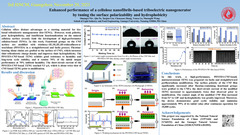
ENHANCED PERFORMANCE OF A CELLULOSE NANOFIBRILS-BASED TRIBOELECTRIC NANOGENERATOR BY TUNING THE SURFACE POLARIZABILITY AND HYDROPHOBICITY
ID:9
View Protection:PRIVATE
Updated Time:2021-11-10 09:38:33
Hits:1551
Poster Presentation
Start Time:2021-11-20 18:00(Asia/Shanghai)
Duration:10min
Session:Po3 The 3rd International Symposium on Nanocellulosic Materials-poster3 (ROOM 3) »
Abstract
Cellulose is the most abundant natural polymer on earth. Because it is renewable, low cost, biodegradable, and biocompatible, it offers distinct advantages as a starting material for bio-based triboelectric nanogenerator (bio-TENG). However, weak polarity, poor hydrophobicity, and insufficient functionalization on the natural cellulose surface severely limit the development of high-performance cellulose-based TENGs. The polarity of the triboelectric material is determined by the chemical properties of the material itself and is closely related to the functional groups present on the material surface. Therefore, as the electronegativity of the functional groups increases, the electron-accepting ability of the material increases, and the material is able to generate more charge. In particular, recently discovered cellulose nanofibrils (CNFs) are stronger than ordinary fiber materials, and are promising candidates for green triboelectric materials. The CNF surface contains abundant hydroxyl groups, which is advantageous for chemical modification, such as sulfonation, carboxylation, esterification, silanization, and polymer graft copolymerization. Fluorine is the most electronegative element; it has a small radius and high ionization energy. Fluorine is most effective at reducing surface free energy while simultaneously improving the hydrophobicity of the material and moisture resistance of the device. In this work, a high-performance, PFOTES-CNF-based, moisture-resistant TENG was prepared via facile and straightforward perfluorosilane modification. Functional groups on the CNF surface are modified with triethoxy-1H,1H,2H,2H-tridecafluoro-n-octylsilane (PFOTES) in a straightforward and facile process. Fluorine-bearing silane chains are grafted to the surface of CNFs, which increases their triboelectric charge density and improves their hydrophobicity. The contact angle of the modified CNF film increased from 52° to 128° and hydrophobicity was greatly improved; the prepared device exhibits excellent moisture resistance. The PFOTES-modified film displayed less attenuation in output performance with increasing humidity than the unmodified film. The PFOTES-CNF-based TENG exhibits good resistance to humidity and long-term cycle stability, and it retains 70% of the initial output performance at 70% ambient humidity. The short-circuit current of the PFOTES-CNF-based TENG reached 9.3 μA, which is about twice that of CNF-based TENG prior to modification. These results clearly indicate that PFOTES can be used to control CNF surface polarizability and hydrophobicity, advancing the search for durable, high-performance, degradable bio-TENGs. Moreover, our work provides insight for further expanding the scope of friction materials.
Keywords
Cellulose nanofibrils; Triboelectric nanogenerator; Surface polarizability; Chemical functionalization; Hydrophobicity
Speaker

Qiu Fu
postgraduate Guangxi UniversitySubmission Author
All Comments
Important Date
-
Conference Date
Nov 20
2021
toNov 21
2021
-
Nov 16 2021
Draft paper submission deadline
-
Nov 18 2021
Contribution Submission Deadline
-
Nov 18 2021
Registration deadline
Sponsored By
China Paper Industry Technical Association
Organized By
South China University of Technology
Contact Information
- Mr. Tao Song
- s******@scut.edu.cn
- 180********
Previous Conferences
-
2025-05-09 China 福州
2027年纳米纤维素材料国际会议 -
2023-04-21 China 北京
The 4th International Symposium on Nanocellulosic Materials

Submit Comment