Presentation Details
Functional-modified cellulose nanofibers and exopolysaccharide nanoparticles: characteristics and applications
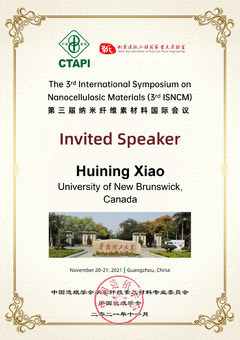
Start Time:2021-11-21 08:30(Asia/Shanghai)
Duration:25min
Session:SC The 3rd International Symposium on Nanocellulosic Materials-Oral Session (ROOM 3) »
Abstract
Keywords
Speaker

Xiao Huining
professor University of New Brunswick, CanadaDr. Xiao, a Professor in Chemical Engineering at the University of New Brunswick (UNB) and the Fellow of Canadian Academy of Engineering, obtained his Ph.D in Chemical Engineering at McMaster University in Canada in 1995. Before joining the UNB in 2001, he was a Lecturer at the University of Manchester in the UK from 1996 to 2001. Prof. Xiao’s research interests mainly cover the functional modification of cellulose including micro- or nanofibrillated cellulose with polymers and nanoparticles; enhancing multi-barrier properties of fibre networks for green-based packaging and foam materials; green-based bioadsorbents for water purification and soil remediation; antiviral/antibacterial-modified cellulose and nonwoven textiles; and smart carriers for controlled release of drugs and agrochemicals. To date Dr. Xiao has published over 320 SCI peer-reviewed journal papers. Since joining the UNB, he has supervised or co-supervised more than 30 PhD students and over 20 PDFs. The PhD students/PDFs under his supervision have also won various prestigious awards including the recipients of CRC Tie 2 in Canada and the National Science Fund of China for distinguished young scholars.
All Comments
Important Date
-
Conference Date
Nov 20
2021
toNov 21
2021
-
Nov 16 2021
Draft paper submission deadline
-
Nov 18 2021
Contribution Submission Deadline
-
Nov 18 2021
Registration deadline
Sponsored By
Organized By
Contact Information
- Mr. Tao Song
- s******@scut.edu.cn
- 180********
Previous Conferences
-
2025-05-09 China 福州
2027年纳米纤维素材料国际会议 -
2023-04-21 China 北京
The 4th International Symposium on Nanocellulosic Materials

Submit Comment