Presentation Details
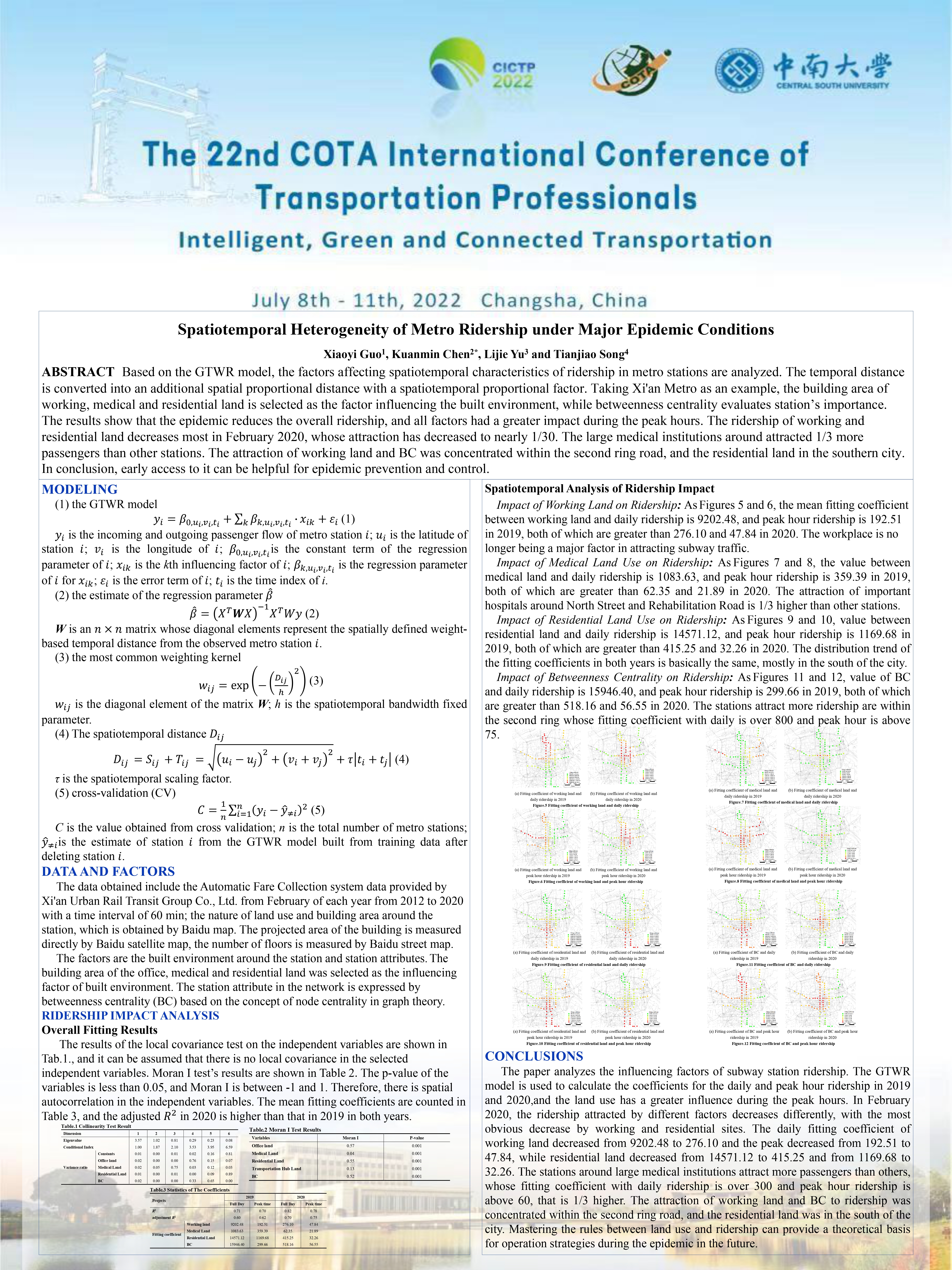
Spatiotemporal Heterogeneity of Metro Ridership under Major Epidemic Conditions
ID:97
View Protection:PUBLIC
Updated Time:2022-07-06 11:57:36
Hits:342
Poster Presentation
Abstract
Based on the GTWR model, the factors affecting spatiotemporal characteristics of ridership in metro stations are analyzed. The temporal distance is converted into an additional spatial proportional distance with a spatiotemporal proportional factor. Taking Xi'an Metro as an example, the building area of working, medical and residential land is selected as the factor influencing the built environment, while betweenness centrality evaluates station’s importance. The results show that the epidemic reduces the overall ridership, and all factors had a greater impact during the peak hours. The ridership of working and residential land decreases most in February 2020, whose attraction has decreased to nearly 1/30. The large medical institutions around attracted 1/3 more passengers than other stations. The attraction of working land and BC was concentrated within the second ring road, and the residential land in the southern city. In conclusion, early access to it can be helpful for epidemic prevention and control.
Keywords
metro; passenger flow distribution; spatial and temporal variability characteristics; land use coefficient; epidemic impact
Speaker

Guo Xiaoyi
Chang’an UniversityAll Comments
Important Date
-
Conference Date
Jul 08
2022
toJul 11
2022
-
Jul 11 2022
Contribution Submission Deadline
-
Jul 11 2022
Registration deadline
Sponsored By
Chinese Overseas Transportation Association
Central South University (CSU)
Central South University (CSU)
Contact Information
- Conference Organizing Committee
- ci******@gmail.com
Previous Conferences
-
2025-07-22 China 广州市(Guangzhou)
第25届COTA国际交通科技年会 -
2024-07-23 China Shenzhen
第24届海外华人交通协会国际交通科技年会(CICTP 2024) -
2023-07-15 China 北京(Beijing)
海外华人交通协会国际交通科技年会 -
2021-12-17 China Xi'an
The 20th and 21st joint COTA International Conference of Transportation Professionals -
2019-07-06 China 南京
The 19th COTA International Conference of Transportation Professionals -
2018-07-05 China Haidian District
18th COTA International Conference of Transportation Professionals -
2016-07-06 China Shanghai, China
The 16th COTA conference International Conference of Transportation Professionals -
2013-08-14 China 深圳市
International Conference of Transportation Professionals

Submit Comment